DoorDash Engineering · Cloud-Based Agents Platform

Delegate engineering work
to cloud‑based agents.

Flux is DoorDash’s cloud-based agents platform for engineers. It hands tasks to secure, autonomous coding agents — so engineers can focus on innovation, critical thinking, and the complex problems that deserve them.

engineering tasks automated
in a single month in 2026
130,000
automated code reviews
every week
25,000+
unique playbooks
in production
300+
playbook invocations
every week
10,000+
scroll

Where we started

The laptop was the bottleneck.

Over the past year, engineers running agentic workloads on their laptops hit the same three walls — each one structural, none of them fixable with a faster machine.

Resources & availability

A laptop has a fixed number of cores, limited memory, and a battery — shared with everything else on board. Agentic work wants parallel builds, tests, and large searches, and it stops cold when the lid closes, the network drops, or the engineer steps away.

work pauses when the laptop closes
Safety controls

Laptops carry broad access to sensitive credentials and systems — SSH keys, VPN sessions, authenticated tools. Handing an autonomous agent that same blast radius is unnecessary risk, and local environments make it hard to tightly scope what an agent can touch, and for how long.

broad credentials, large blast radius

Visibility & auditability

When execution is fragmented across hundreds of individual devices, no one can answer the basic questions: what is running, where, on whose behalf, and which systems or files it has touched.

fragmented execution, no audit trail

Before — agents on laptops

  • Bound to one machine’s CPU, memory & battery
  • Paused by closed lids and dropped connections
  • Agent inherits broad local credentials
  • Execution invisible and unauditable

After — agents on Flux

  • Runs unattended, in parallel, around the clock
  • Isolated cloud sandboxes with hardware-level isolation
  • Only the scoped permissions each task declares
  • Every action logged, centrally observable

Why we built it in-house

Hosted agents force a hard tradeoff.
Flux refuses it.

Option A

Send sensitive code and execution context to a third-party hosted agent.

Code leaves the building.

Option B

Open a path from that third party back into internal systems.

The network opens the door.

“Getting an agent to write code is mostly solved. The harder problem was giving that agent the right environment, tools, permissions, integrations, and constraints.”

— the Flux thesis, from the DoorDash engineering post

So DoorDash controls the primitives around the agent — orchestration, sandboxes, workflows, permissions, integrations, and DoorDash-specific context — designed to be modular: the best third-party tool for each job, built in-house where deeper security, integration, performance, or UX ownership matters.

Primitives, not workflows

Four primitives. One delegation loop.

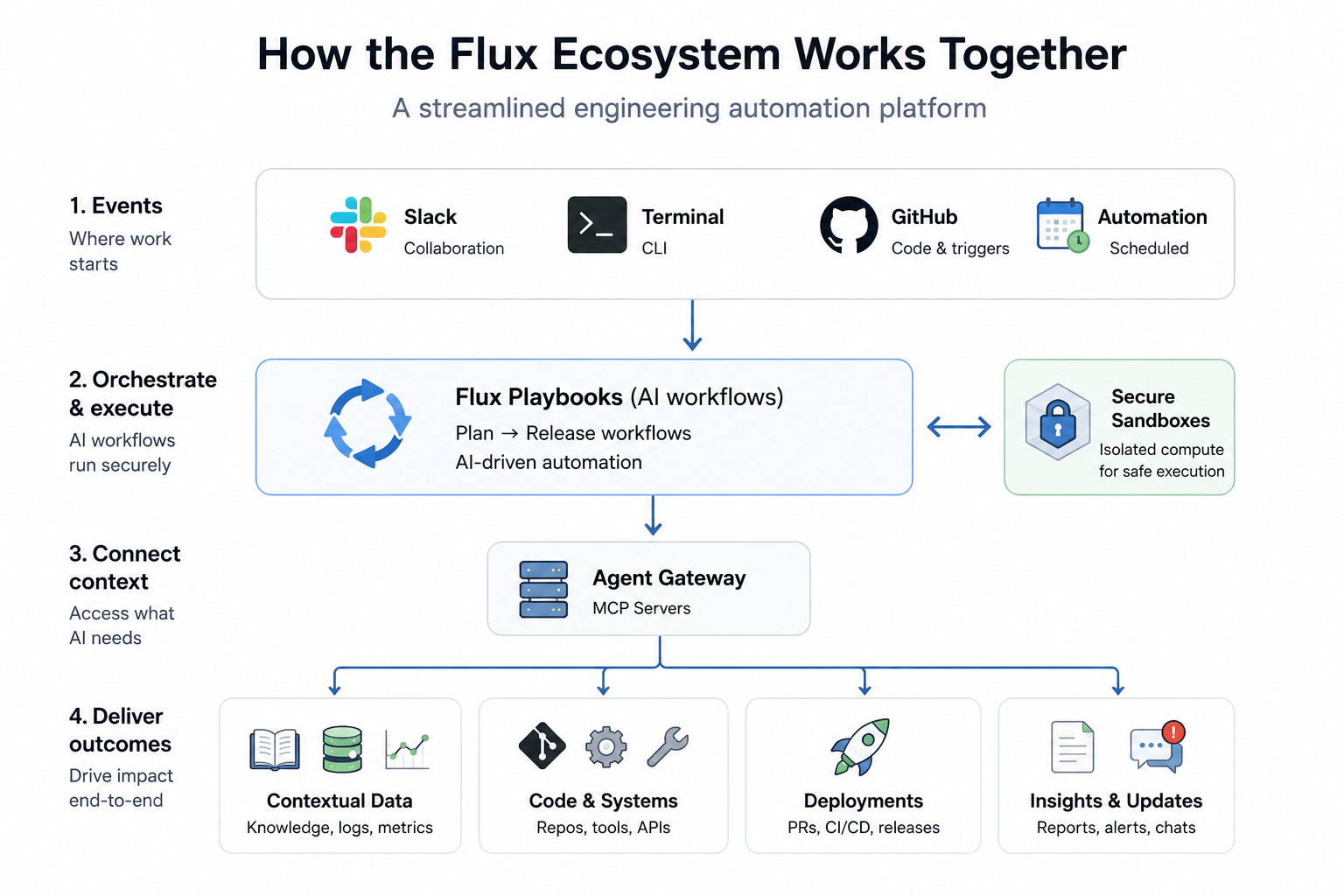
A playbook defines the work. A cloud sandbox gives the agent a real place to do it. Agent Gateway controls what systems the agent can reach. Invocation surfaces let engineers start and receive work where they already are. Because these are primitives — composable, not prescribed — teams build new agent workflows without reworking any infrastructure.

  1. Work
    completed
    PRs · reviews · reports

A task packet travels the loop — triggered from any surface, defined by a playbook, governed by the gateway, executed in an isolated sandbox. Select a stage to inspect it.

Sandboxes provide the execution environment

Flux moves execution into isolated cloud sandboxes backed by Firecracker microVMs — hardware-level isolation for every run. Each sandbox is provisioned with the repositories, developer tools, secrets, and runtime dependencies the task requires: a complete engineering workspace with a consistent execution, security, and observability model.

Controlling this layer is what lets Flux support real engineering workflows — including changes across multiple repositories and multiple pull requests from a single session.

  • Firecracker microVMs — hardware-level isolation per run
  • Provisioned with repos, dev tools, secrets & runtime deps
  • Multi-repo changes, multiple PRs, one session
  • Consistent execution, security & observability model

End-to-end sandbox setup

p95 SLO < 5s

microVM start repo clone build tools agent harness config

From starting the microVM to cloning the required repositories, installing build tools, and configuring the supported coding-agent harnesses — the full end-to-end setup holds a 95th-percentile service-level objective under five seconds.

Invocation surfaces

Meets engineers where they work.

No new dashboard to adopt, no portal to remember. The same playbook fires from the place the work already happens — and the results come back to that same place.

Slack

Collaborative delegation. Engineers see what others delegate, watch Flux make progress, and review the output — together, in public threads.

@eng flux: review the payments-service PR queue

flux ● 3 playbooks invoked — posting reviews in thread…

illustrative exchange

GitHub

PR and CI automation. Reviews, triage, and follow-ups attach to the pull request where the work is already happening.

flux reviewed #4812 · 2 suggestions · tests green

ci / build — passing

illustrative automation

Cron

Recurring maintenance that never sleeps — scheduled monitoring and upkeep playbooks firing around the clock, unattended.

0 6 * * 1 # weekly dependency sweep

*/15 * * * * # scheduled monitoring

illustrative schedules

CLI

Direct developer control. Invoke any playbook from the terminal, or through a conversational skill when the moment is more fluid.

$ flux run code-review --repo payments --pr 4812

▸ sandbox ready in 4.1s · agent running

illustrative invocation

Skills

A conversational skill can invoke the same playbook — the fifth surface, for when delegation is a dialogue rather than a command.

@eng “triage last night’s CI failures and file follow-ups”

flux ● CI-triage playbook invoked

illustrative exchange

Flux at scale

After a Q1 2026 debut, the numbers did the talking.

0
engineering tasks automated in a single month in 2026
0+
automated code reviews, every week
0+
unique playbooks in production
0+
playbook invocations, every week

These workflows run unattended, in parallel, around the clock — high-volume background work across all of DoorDash engineering.

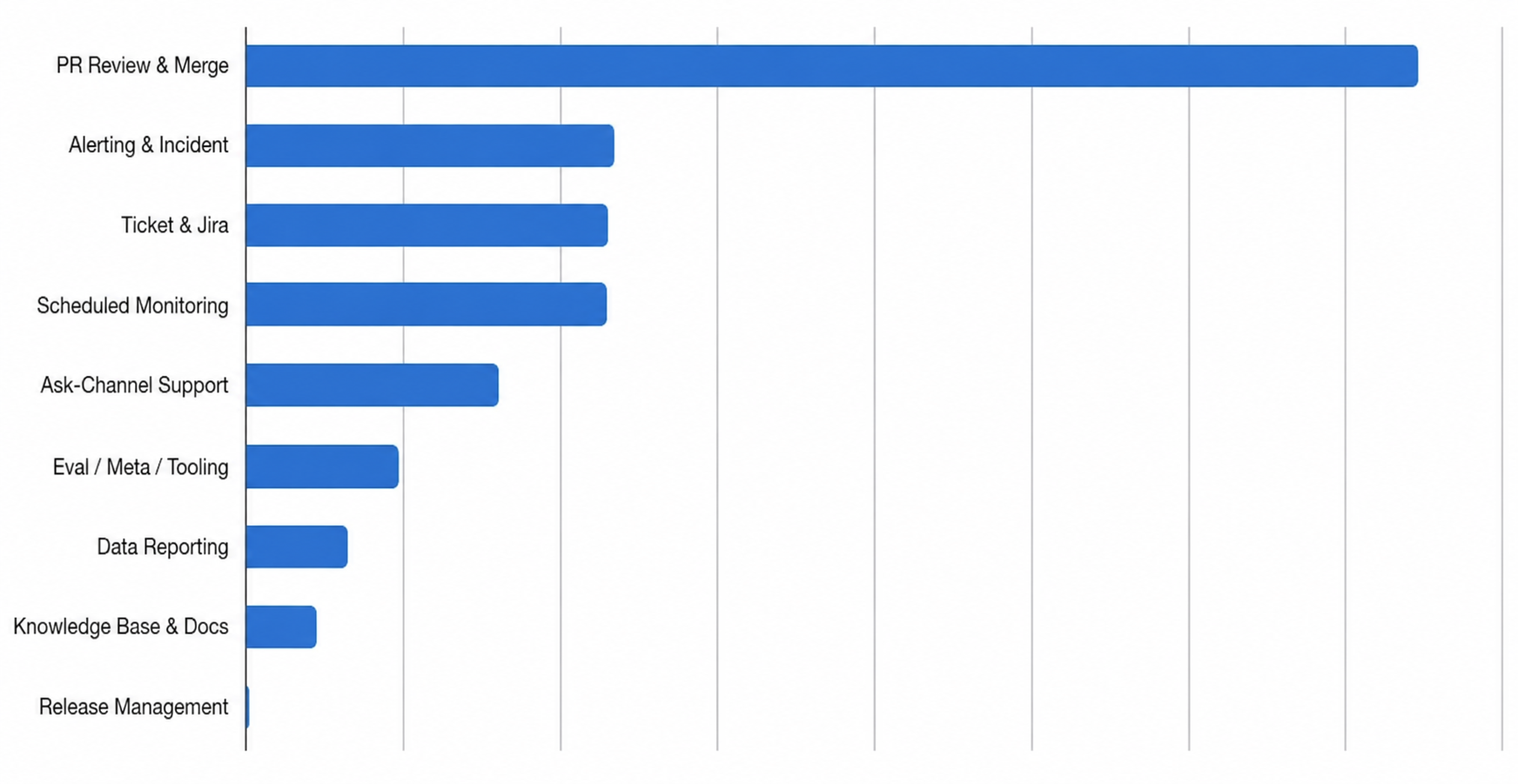
Where the delegated work goes

A snapshot of Flux background-workflow usage across DoorDash in a single month — rebuilt live from the post’s Table 1. Category shares are proportional; the original figure published without axis values.

Adapted from Table 1, “Delegating Engineering Work To Cloud-Based Agents” — automated code reviews, playbook runs, and background task completions.

Lessons learned

Flux taught as much about adoption as infrastructure.

  1. Start narrow to earn trust

    Flux began with automated code review — not the entire software development life cycle. Review was frequent, measurable, and easy for engineers to evaluate: a production workflow where quality, latency, cost, and behavior could be tuned before expanding into CI triage, on-call tasks, maintenance playbooks, and ticket-driven development.

    code review → CI triage → on-call → maintenance → ticket-driven development

  2. Make the work visible

    The first Slack integration created private channels for each agent run — useful for individuals, but it never created team habits. Moving work into public threads changed the adoption pattern: engineers could see what others delegated, watch Flux make progress, review the output, and build trust together.

    private channels → public threads → team habits

  3. Playbooks need enablement

    Reusable workflows don’t appear just because the platform exists. Workshops and hackathons helped teams translate repeated operational work into playbooks. The primitives made automation possible; enablement helped teams recognize which workflows were worth encoding.

    primitives make it possible — enablement makes it real

What’s next

The platform keeps compounding.

The full story

130,000 tasks a month didn’t come from a bigger laptop.

They came from treating delegation as a platform: primitives instead of workflows, governance instead of blind trust, and surfaces engineers already live in. Read the engineers’ own telling of how Flux got here.

Read “Delegating Engineering Work To Cloud-Based Agents”

As published in the original post

Original Figure 1 from the post: the four Flux platform primitives — events from Slack, Terminal, GitHub and scheduled automation flow into Flux playbooks, connect to secure sandboxes and the Agent Gateway, and deliver outcomes.
Figure 1 — the four platform primitives, as published
Original Table 1 from the post: a bar chart snapshot of monthly Flux usage across DoorDash, led by PR review and merge, then alerting and incident, ticket and Jira, scheduled monitoring, and others.
Table 1 — a month of Flux usage, as published
View more demos Get $10 off Kimi K3